
How Much Protein Do Women Really Need? A Simple Guide for Fat Loss, Strength & Everyday Life


If you've spent any time on social media lately, you've probably noticed that protein is everywhere.
High-protein breakfasts. Protein coffee. Protein bars. Women sharing how they eat 120 or even 150 grams of protein every day.
And while protein is important, all this information can leave you wondering:
Am I eating enough protein? Do I need to track it? And what happens if I don't reach 100 grams every day?
If you're a woman trying to lose body fat, build strength, or simply improve your eating habits, you don't need to follow someone else's protein target.
You need to understand how much protein makes sense for your body, your activity level, and your goals.
In this guide, we'll break down what you actually need to know about protein and, more importantly, how to apply it to your everyday meals.
1. Why is protein important for women?
Protein is one of the three main macronutrients, alongside carbohydrates and fats.
Your body uses protein to build and repair tissues, produce enzymes and hormones, support immune function, and maintain muscle.
For women who exercise or want to improve their body composition, protein has a few particularly useful benefits.
It helps maintain and build muscle. Strength training provides the stimulus for your muscles to adapt, while dietary protein supplies the amino acids needed for repair and growth.
It supports muscle maintenance during fat loss. When you lose weight, you can lose some muscle along with body fat. Eating adequate protein and continuing resistance training can help reduce muscle loss.
It can help you feel satisfied after meals. Protein-rich meals often increase fullness, which may make it easier to manage hunger while working toward fat-loss goals.
It becomes especially relevant as we age. Muscle mass and strength tend to decline with age, particularly if we're inactive. Resistance training and adequate protein are two useful ways to support healthy aging.
But here's something important: eating more protein alone won't automatically build muscle or cause fat loss. Your overall eating habits, training, recovery, and consistency still matter.
2. How much protein do women actually need?
This is probably the biggest question, and the answer depends on your activity level, body size, and goals.
The general recommended dietary allowance (RDA) for healthy adults is 0.8 grams of protein per kilogram of body weight per day. This is a baseline intended to meet the needs of most healthy adults, not necessarily an optimal target for building muscle or supporting demanding training.
For women who exercise regularly, especially those doing strength training, research commonly supports around 1.4–2.0 grams per kilogram per day.
For example, a woman who weighs 70 kg and strength trains regularly might use a target of around 98–140 grams daily, depending on her needs and goals.
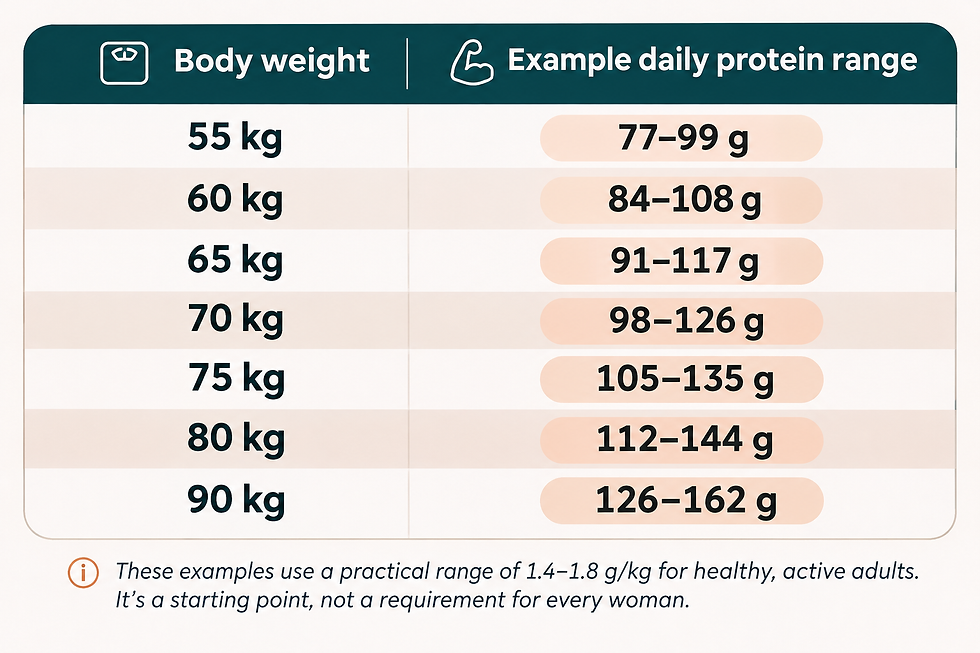
Protein examples based on body weight
The table below uses a practical range of 1.4–1.8 g/kg for healthy, active adults. It is a starting point, not a requirement for every woman.
3. Do women really need 100 grams of protein every day?
Not necessarily.
One hundred grams is a popular number on social media, but it isn't a universal requirement.
For example, a woman who weighs 55 kg and exercises a few times per week may have different needs than a woman who weighs 85 kg and trains intensely.
Your protein needs aren't determined by being a woman alone.
They're influenced by your body size, age, activity, health, and goals.
Instead of asking, "How can I force myself to eat 120 grams of protein?" a better
question is:
"Am I including enough protein in my meals to support my goals?"
For many beginners, improving the amount and consistency of protein at regular meals is a useful first step before worrying about exact numbers.
4. How much protein should you eat at each meal?
One common pattern I see is eating very little protein during the first half of the day.
Breakfast might be coffee and toast. Lunch might be a small salad. Then dinner becomes the meal where most of the day's protein is consumed.
There's nothing inherently wrong with having a larger dinner, but spreading protein across meals can be a practical way to reach your needs and support muscle protein synthesis.
For many active adults, approximately 20–40 grams of protein per meal is a useful general range, depending on body size and total daily needs.
Example: Spreading 100 grams across a day

You don't have to eat exactly this way. It's simply an example of how protein can fit into a normal eating routine.
And if you occasionally eat less protein at breakfast or miss a snack, you haven't ruined your progress.
Your overall daily intake matters more than perfectly timing every meal.
5. Does eating more protein help with fat loss?
Protein can support fat loss, but it doesn't directly burn body fat.
Fat loss generally requires a sustained calorie deficit, meaning your body uses more energy than you consume over time.
Protein can make that process easier in two important ways.
First, protein-rich meals can help you feel fuller and more satisfied. This may make it easier to manage hunger without constantly thinking about food.
Second, adequate protein combined with strength training can help preserve muscle while losing weight.
This matters because the goal for many women isn't simply to weigh less. It's to reduce body fat while maintaining strength and muscle.
However, adding protein bars, shakes, and high-protein snacks on top of everything you already eat won't automatically result in fat loss.
The overall balance of your meals still matters.
Practical tip: Instead of adding extra food just to increase your protein intake, look at the meals you already eat. Can you include a protein source that makes the meal more satisfying?
For example, if you normally eat a salad for lunch and feel hungry an hour later, try adding chicken, tofu, beans, tuna, or another protein source you enjoy.
You don't need to remove the carbohydrates or fats from your meal to make room for protein. All three macronutrients have important roles.
Do you need the same amount of protein on rest days?
Generally, yes. It's useful to maintain a reasonably consistent protein intake throughout the week.
Your muscles don't stop recovering the moment you leave the gym. Muscle repair and adaptation continue between workouts.
You don't need to drastically increase protein on training days or reduce it on rest days.
For most women, a consistent routine is easier to manage than changing protein targets every day.
Final thoughts: You don't need to make protein complicated
Protein is important, especially if you're working toward building strength, improving body composition, or maintaining muscle as you age.
But you don't need to turn eating into another stressful task.
You don't need to copy someone else's 150-gram meal plan. You don't need protein powder in every meal. And you don't need to feel guilty if one day doesn't go according to plan.
Start by looking at what you're already eating.
Choose one meal where you could include a little more protein. Practice that change until it feels normal, and build from there.
Because the best nutrition plan isn't the one with the most impressive numbers. It's the one that supports your goals and that you can actually maintain.
If you'd like help combining strength training with realistic nutrition habits, explore the personalized coaching options at
References and further reading
The article draws on established sports nutrition and protein research, including:
International Society of Sports Nutrition Position Stand: Protein and Exercise (2017) — protein requirements, distribution, and exercise.
Morton et al. (2018), Protein Supplementation and Resistance Training — systematic review and meta-analysis of muscle and strength outcomes.
International Society of Sports Nutrition Position Stand: Nutritional Concerns of the Female Athlete (2023) — female-specific nutrition considerations.
NIH Office of Dietary Supplements: Nutrient Recommendations — dietary reference intake background.


Comments